The World’s First Beekeeping Donkey

Beekeeping in the US is mainly done for recreational reasons. It is nice to be able to eat your own honey or make a small profit from selling it on but producing it is very rarely done in order to earn enough to survive. The same cannot be said of Brazil, where nearly half of the population lives in poverty and one in ten people survives on the equivalent of seventy six dollars a month. Residents of the town of Itatira in the northeastern part of the country rely on beekeeping as their main source of income. An estimated one in fifteen people there are beekeepers, making it the largest honey producer in its state despite the fact that it only has a population of a mere two thousand and eighty one people. Not all of the beekeepers in Itatira fall under the bracket of ‘people’ though because it holds the prestigious title of the home place of the world’s first beekeeping donkey.

No Ordinary Donkey

Eccentric Brazilian beekeeper Manuel Juraci is one of the most successful beekeepers in Itatira, partly due to his helper Boneco, who accompanies him to the hives and helps him to transport the honey that he collects to the local market. Boneco is a donkey but he is no ordinary donkey. He wears a custom-made beekeeping costume that his owner has made for him and enables Manuel to sell far more honey than he would be able to do if he had to carry it all himself. Manuel was the first beekeeper to think of kitting a donkey out in a beekeeping costume to prevent it from being stung and has consequently become the most productive beekeeper in the area, gaining a reputation for earning significantly more than his peers.

Demand for Donkey Beekeeping Suits

The competitive edge that Boneco provides Manuel with is so great that the Brazillian Association for Honey Producers got in touch with him after hearing his story and asked him if he would be interested in making suits aimed at protecting other animals. Manuel is still considering the offer but has expressed the fact that it is not just Boneco’s ability to carry large loads that makes him the ideal beekeeping companion. He says that he has developed a genuine bond with the creature and that the companionship that Boneco offers has made his job a great deal easier. People say that a dog is a man’s best friend but in the case of Manuel, it is a donkey.

No Laughing Matter

Hilarious as a donkey-shaped beekeeping outfit might seem, Manuel’s invention could be hugely beneficial to beekeepers in poor countries, as it has the potential to significantly increase their productivity. Taffline Laylin of the environmentalist news website Green Prophet suggests that the innovation could be of great use to beekeepers in Turkey and Lebanon, who are responsible for keeping the vulnerable bee populations there from descending into collapse. Bee keeping is an age-old profession in these countries that has been passed down through the generations, especially in mountainous regions of Lebanon, where mulberry trees grow. Today there are between five and six thousand beekeepers in the country and an estimated one hundred and eighty thousand hives that produce between eighteen thousand and twenty thousand tonnes of honey a year. Almost a third of the nation’s population is below the poverty line so surely anything that can boost the income of the locals can be considered to be extremely valuable and well worth investing in.

Laylin points out that donkeys are essential to many people in the Middle East, which means that there would be no shortage of them available to aid the region’s beekeepers if the concept of donkey beekeepers was to catch on. Were honey-carrying donkeys to become popular, beekeepers across the world could well be paying suppliers handsomely for these suits, meaning that Manuel could potentially make a large amount of money from his wacky invention. This would enable him to buy Bonoco all the treats that he wanted and demonstrate appreciation for a friend who catapulted him from the position of a low-paid, run-of-the-mill beekeeper to one of the most successful beekeepers in the region with global interest in his techniques.
Overwintering Success - not just for the faithful…

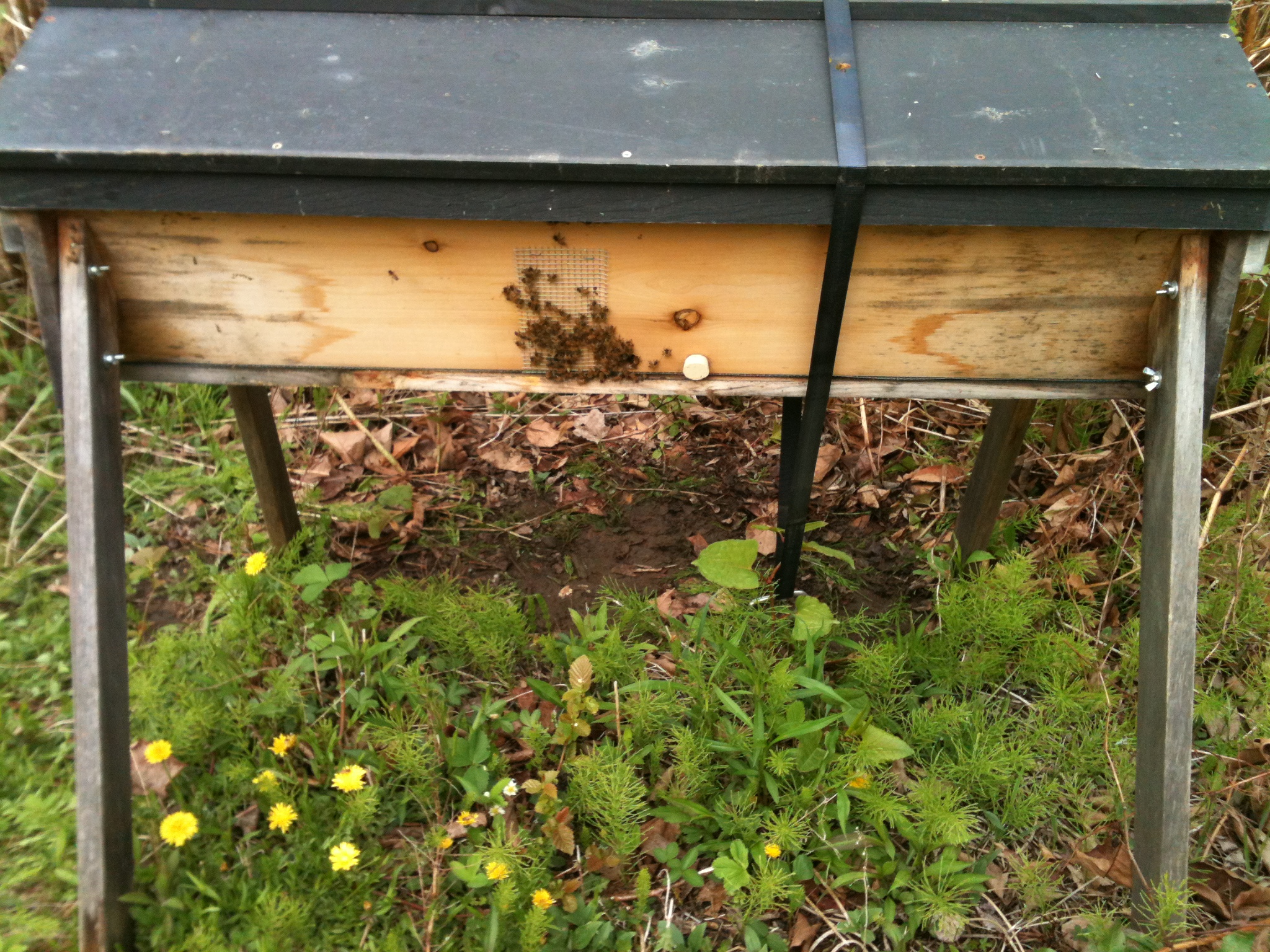
So, last year I kept four Gold Star top bar hives - three at my house, and one at the L.O.C.A.L. garden a few miles away - a garden associated with the culinary arts program through Regional School Unit #1.

Now, I live in a beautiful spot - I can see water out three sides of my house. I have an osprey nest in the top of a very tall snag in my backyard - I can watch it through my living room window, kicking back in my recliner. It’s really very nice here.

Unfortunately, it’s also right across the street from Whiskeag Creek in Bath, Maine. And that means it’s windy. It’s a veritable wind tunnel, in fact. So the hives that I have been keeping at home have always had a tough time of it. So tough in fact that I lost all three this year - even though it took until March for the last one to crash.

But darn it, that’s depressing. So depressing in fact, that I didn’t even go check on the fourth hive - tucked into the corner at the garden. I just figured they hadn’t made it. Wrote them off. Even ordered another package to go in that hive!

But Thursday I went by there - thinking I’d clean the hive out in preparation for bee arrival next week… and much to my delight - they were still kicking. More than that, they are THRIVING. They’ve even got a crop of drones going and a few small queen cups in the works - in the first week of May!!!

So I unwrapped them, (they’d been wearing a tarpaper wrapper for the winter) and opened a second entrance, and did a partial inspection. I’ll need to correct a few places on one side where they’ve cross-combed a bit - so I’ll be bringing a container as I suspect this will mean there will be a small honey harvest. I might even take the opportunity to split them, since they’re so raring to go already…

All I can think to say is “Oh me of little faith…”

Thank you to the bees, for being so restorative. *grin*

Pollen-free? Not for me!

Today on Kim Flottum’s CATCH THE BUZZ Email: There’s More To The Highly Filtered Honey Story. Read more here: http://home.ezezine.com/1636/1636-2012.04.24.08.36.archive.html

People — POLLEN is not an IMPURITY!

So I have to wonder - WHY would anybody filter all the life-giving wonder out of the most amazing, special, magical, sacred food on the planet? Have we become THAT disconnected to think that POLLEN is an unwanted thing in HONEY?

It’s a bit like peeling a potato and eating only the starchy insides, throwing away the nutrient dense skin. Well, isn’t it?

Or… are the honey packers hiding something? And if so, what? Who would want honey that had been stripped of its signature nectar source or geographical origin? Or are they just taking advantage of the fact that not enough of us are aware (yet) that honey can be so abused by processing, and made valueless (in the search for the almighty dollar,) and yet still be beautiful enough to be sold as honey? Even though it’s essentially *dead* at that point?

A jar full of glowing golden liquid, with light shining through it - is beautiful - but you can get the same effect by collecting pretty bottles and filling them with colored water.


A veritable rainbow...

Red, Orange, Yellow, Honey...

So without the pollen, where’s the value in honey? I mean, I guess we all used to want the perfect, round, red, unblemished apple… thinking it some sign of “new and improved”, or “perfection” - or maybe we just hoped it would impress the teacher better… But aren’t we past that grade school mentality by now? Don’t we get it that nature is a little messier than that? A little more “real”? That it requires a little more of us - that it requires us to think, to understand, to actually be connected to it, to know that we are a PART of it?

And - pay attention, pollen allergy sufferers (like me) - there is no MEDICINE in the honey if there is no POLLEN in it. Just as well put sugar in your tea for all the health benefit it provides… Which is why, if you have pollen allergies, you want unprocessed honey from as local as you can get it… like for instance, your own backyard.

So if this makes sense to you - and if backyard beekeeping is something you’ve been wondering about - go to http://www.goldstarhoneybees.com to learn how you can become your own backyard beekeeper - and have REAL honey - pure, natural honey that is FREE of the chemicals that industrial beekeepers use in their hives, and FULL of the lovely pollen that prevents honey from being a runny, crystal clear, amber colored, liquid sweetener - kind of like brown Splenda in a Squeezy Bear. Get the real deal. Because it matters. Really, it does.

The resourcefulness of beekeepers…

Recently I read a response to a blog post on Dennis Murrell’s Natural Beekeeping blog. Dianna wrote to describe how she had recycled oak fence boards into a Warre hive with her circular saw, for next to nothing in $$$ and happily, still has all her fingers!

We thought she was pretty smart, and the oak must look awesome!

Here’s what we said back to her:

Dianna – What a great example of recycling and resourcefulness! We would love to see a pic of your Warre hive – maybe you could post it on our Facebook page? It’s here: http://www.facebook.com/goldstarhoneybees and we love to see pictures! (We also love it when you click “like”if you like our Facebook page!)

There are a lot of extremely resourceful beekeepers out there – and many of them with a very well developed woodworker “gene”. They also understand the value of having interchangeable parts - so that beekeepers can work together. They understand that “a hive can save a hive” - an open bar of brood is the natural solution to a queenless hive. But the parts have to fit between hives!

So in addition to our “bells & whistles” Deluxe TBH hive ($495), which comes as a complete kit, we also have the plans for a Gold Star hive kit in both of our DIY kits - DIY#1 ($50) AND DIY#2 ($295).

The Deluxe kit contain all the wood, the glass window, the hardware, painted roof - everything - and goes together with nothing more than a screwdriver and a staplegun -

But with the DIY #1, YOU do ALL of the woodworking, and you are building the same box you see for sale on the website - and you know that it matches up with all existing Gold Star hives.

With a DIY #2, you build the box, roof and legs, but you GET the top bars. And if you’ve GOT the top bars, then you want to be darned sure it all works together, so we also include the follower boards. We like to call those follower boards “the keys to the kingdom” - because if you build the box to be a fit to the followers, then the top bars will also be a perfect fit. Voila! Gold Star quality, and hive interchangeability!

Both DIY kits include all the hardware as well. This is our response to the “Big Box Bubble Pack” – where you have to buy a plastic bubble package containing 60 of something you only need 14 of. Or a 100 foot roll of hardware cloth/screen that you only need 4 feet of.

And as Dennis mentioned - it’s very nice to have all your fingers - we think beekeepers should be able to count to ten! You can read Dennis’ blog (in its new format!) here: http://beenatural.wordpress.com/

There’s a video about our different kits here: http://youtu.be/AR_yaFnLnkU

You can find our website here: http://www.goldstarhoneybees.com.

And you can ask us questions here: [email protected]

Thanks for listening!

Christy Hemenway

Gold Star Top Bar Hives since 2007